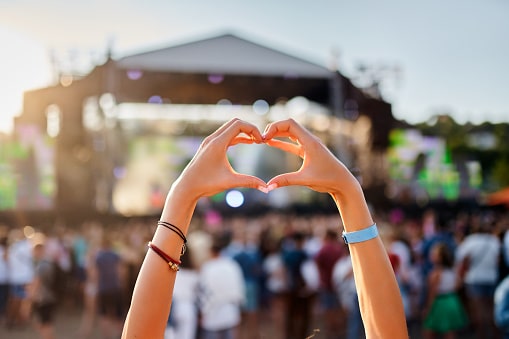
Summer in Utah means multi-day festivals with exciting lineups, vibrant outdoor stages and the shared energy of a crowd. Of course, concerts and festivals can reach incredibly high volumes, so let’s discuss how you can fully enjoy your festival experience without putting your hearing health at risk.
How Loud Noise Damages Hearing
The louder the sound, the bigger and more powerful its sound wave. Large sound waves can damage the delicate sensory cells in our ears that are critical to our ability to perceive sound.
Sounds can damage our ears starting at 85 decibels, which is about the level of your blender or heavy traffic. As sounds exceed 85 dB, they take less time to cause damage. Live music events can reach 100 dB and higher, and at that level, damage can start in just 15 minutes. At music events that take place over multiple days, the damage can really add up.
How to Protect Your Ears
You don’t need to miss out on a good concert or sacrifice sound quality while you’re there; there are plenty of tools and strategies you can use to protect your hearing at an outdoor festival.
Hearing Protection
Earplugs are the most common form of hearing protection, and for good reason: they’re easy to find, inexpensive and very effective. Disposable foam earplugs can be found at nearly every supermarket or pharmacy. Many music lovers go a step further and get custom-made high-fidelity earplugs designed to reduce volume evenly across frequencies, which prevents sound distortion.
Control Exposure
Where you sit or stand in the audience can make a huge difference. Avoid standing directly in front of or under speaker stacks and stay in the mid-crowd or slightly off to the side for a safer listening zone.
You should also take regular breaks from the loud noise. Your ears need a chance to rest and recover. Step away from the speakers frequently.
If You Have Hearing Loss
If you already use hearing aids or experience hearing loss, music festivals can still be an accessible and exciting experience with some preparation. Bring backup batteries or a portable charger (depending on whether you use rechargeable devices or use replaceable batteries), so you’re not caught without a way to hear. You should also ask your audiologist about creating a custom listening program for outdoor live music events.
How to Tell You’ve Sustained Hearing Damage
In the hours or days after the festival, you may notice some changes to your hearing. Some possible changes include:
- Muffled sound
- Difficulty hearing high-pitched noises
- Difficulty hearing background noise
- Ringing or buzzing in the ear (tinnitus)
- Pressure or a feeling of fullness in the ear
- Sound sensitivity (hyperacusis)
Some of these may be temporary, but please note that even if your hearing returns to normal after a day or two, your ears may still have lingering trauma from the loud noise. It’s a good idea to visit an audiologist for a comprehensive hearing examination.
If you already wear hearing aids and notice that your devices are acting up after the concert, contact us about a service appointment. Loud noises can damage the internal circuitry and processors of your hearing aids. Call us so we can check on that for you.
We at South Valley Ear Nose & Throat – West Jordan want you to have an enjoyable concert experience while still maintaining your good hearing health. If you have any questions about hearing health or hearing protection, call us and we’d be happy to chat with you more about it.