After you finished your hearing test, your audiologist showed you your results on an audiogram and discussed your hearing loss and the benefits of hearing aids. These powerful hearing devices are tailored to meet your individual hearing needs and improve your quality of life and overall well-being. This conversation with your audiologist was the beginning of an amazing journey. The next step is the hearing aid fitting.
The Benefits of a Customized Hearing Aid Fitting
Your audiologist at South Valley Ear Nose & Throat – West Jordan does so much more than just put headphones on you for a hearing test and then put generic hearing aids in your ears. Our personalized hearing aid fitting process includes ensuring your hearing aids fit comfortably, the settings meet your hearing needs and counseling to help you adapt to this new phase of life.
For example, your hearing aid settings must be fine-tuned. If your devices simply “turned the volume up” on the whole world, it could make some sounds too loud and worsen noise-induced hearing loss, while making the sounds you struggle to hear only slightly more audible. This isn’t a good solution to your hearing needs. Instead, we will use your audiogram to adjust your hearing aids to amplify the pitches you need help hearing. It’s imperative to us that your devices work for you.
What Happens at the Fitting Appointment
The hearing aid fitting appointment will include a few phases. Here is what to expect at each step.
Programming
As discussed above, your audiologist will tailor the sound settings in the hearing aids according to your audiogram. They may do this step with you, or they may do it before you arrive at the clinic.
Trying Them On
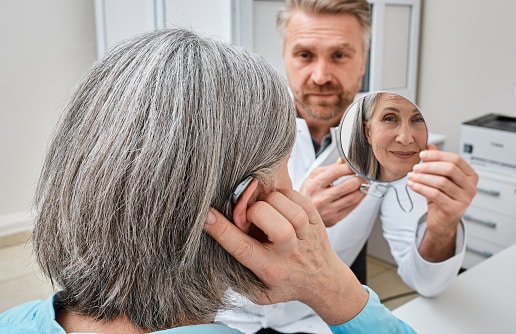
Here’s the exciting part: trying them on! Your audiologist will insert your new hearing aids and check for a secure, comfortable fit. Even the most perfectly programmed hearing aid will struggle to deliver the help you need if it doesn’t fit properly. An ill-fitting hearing aid can cause muffled hearing, annoying feedback and the occlusion effect1, so speak up if you feel pressure or like the hearing aid might fall out; those could be issues with the fit.
Real Ear Measurement
Now that your hearing aids have been customized to both your hearing needs and ear shape, the next step is the real ear measurement, which verifies that everything is in its place and ready to go. Your audiologist will gently place a tiny microphone into your ear canal, then insert your hearing aids on top of it. They will then test that your hearing aids are amplifying sounds into your ear correctly by using a test audio and picking it up with that microphone.
Counseling
At this point, your hearing aids are pretty much ready to go, and now you and your audiologist will have a dialogue on caring for your devices, how to insert and remove them properly, adjusting the settings, managing the battery (either changing them if your devices use replaceable batteries or charging them if you have rechargeables) and go over using any extra features, such as Bluetooth® or telecoil.
It can feel overwhelming to take in all this new information. Don’t worry: these feelings are temporary, and your audiologist is here to help you with this adjustment.
If you have any questions before your hearing aid fitting appointment, or if you need to get on the calendar for a hearing test, call South Valley Ear Nose & Throat – West Jordan today.
1 Stone, M. A., Paul, A. M., Axon, P., & Moore, B. C. (2014). A technique for estimating the occlusion effect for frequencies below 125 Hz. Ear and hearing, 35(1), 49–55. https://doi.org/10.1097/AUD.0b013e31829f2672